Pages

Showing posts with label oil. Show all posts

Thursday, June 6, 2013

Blended Standards

Is E15 Gasoline Safe?


Blended gasoline and ethanol fuel choices
 ~ The American Petroleum Institute (API) is fighting the EPA over how much ethanol should be blended into gasoline. Is 15% ethanol content, E-15, safe for modern cars?
The [EPA] and the biofuels industry say the blend — which contains 15 percent ethanol, rather than the standard 10 percent — is safe for those vehicles.

But the oil and gas industry has produced studies finding that the mix would damage vehicle engines, and some automakers have said they would not honor warranties in cases where E15 was used.

“E15 could leave millions of consumers with broken down cars and high repair bills,” said Bob Greco, API group downstream director. “It could also put motorists in harm’s way when vehicles break down in the middle of a busy highway. We are asking the Supreme Court to step in and protect consumers by striking down EPA’s dangerous E15 mandate before it’s too late.”
Well, of course it "could". But will it? The API's studies have been called "scientifically weak" and there are, naturally, many other studies that show no harm. Could it be that the science is not settled?

Reminds me of another contentious argument of interest to the API...


Thursday, May 30, 2013

Choosing Profits Over Planets

From the Mouths of Boobs


Rex Tillerson, Exxon CEO
 ~ "What good is it to save the planet if humanity suffers?"

So said CEO Rex Tillerson at Exxon's annual meeting yesterday. What really concerns him, of course, is less the suffering of humanity than the suffering of diminished profits. The right choice between the planet and profits? Yes! More money! Never mind that there is no business to be done on a dead planet. Or that you can't take it with you. Or that dispensing with the Earth, our only home, is somehow a reasonable option in service of unbounded cupidity. But then T. Rexx has some puzzling beliefs.

Thursday, May 23, 2013

Another Kind of Oil Rig

I'm Shocked. Shocked!


Shell official walks away, head hanging
 ~ Ho hum. Another case of a rapacious global corporate cartel caught doing what comes naturally.

European officials are investigating BP, Shell and Statoil for fixing the price of oil. The US may do so as well.
[UK Energy officials] said manipulation of the oil price could have driven inflation and pointed out that the market is an important benchmark for many financial transactions.

High oil prices also feeds through to bigger bills for food, clothes and other essentials because it pushes up the cost of transport and manufacturing.

A high oil price will also fuel inflation, which erodes the value of people’s savings, and can stifle economic growth, by pushing up businesses’ costs.
The economic impact of artificially inflated oil prices is huge; $20T worth of oil is priced from the Brent crude index, a focus of investigators. As with the LIBOR rate fixing scandal, it turns out the largest players "report" prices which are then aggregated and used as the benchmark for everyone else. What stops them from playing games with those reports? Nothing, except apparently the danger of being caught due to an excess of greed.

Thursday, May 16, 2013

Another Market Failure

Heads I Win, Tails You Lose...


coin toss
 ~ When oil is cheap there is little incentive to develop and commercialize biofuels or other liquid alternatives. Especially since they largely remain generally more costly than conventional hydrocarbons.

But when the price of a barrel of oil rises, alternative energy fuels will surge, right?

Actually, no:

Sunday, May 12, 2013

What Big Oil Can Learn from the Gun Manufacturers

Astroturfing Savvy


 ~ Big Oil could learn a lot about faking broad public support from the gun lobby.

Big Finance astroturf how-to

Thursday, May 9, 2013

Carbon Intoxication

Scientists are Not Immune


 ~ I've been formally trained as a computer scientist, and at one time made a very good living from it at a top institution. However, just because I am a "scientist" it does not mean that I am qualified to discourse on scientific subjects at large.

This does not, however, much deter some scientists from fulminating well outside their areas of expertise or qualification. Or spouting their personal beliefs from ideologically aligned platforms. Today we have been treated to another tired retread of an article in the Wall Street Journal by climate change simpleton William Happer. Along with astronaut Harrison Schmidt, he claims, again, that more atmospheric carbon is good for us because we need plants, and plants need carbon dioxide.

Much of the article can be dismissed on factual grounds with reference to what actual climate science and climate scientists can tell us. (I'm no expert—being a computer scientist does not make me a general scientific expert—and I happily defer to those who are.) Happer and Schmidt focus on the tired and discredited trope that carbon concentrations have been higher in geological time (true) but ignore the recent, and utterly unprecedented rate of change in those concentrations. Sure, life flourished, but not human life, and species that cannot adapt to a changing environment not infrequently suffer or become extinct. Evolution does not work well in short time periods of rapid environmental shift.


Sunday, April 21, 2013

Long-Term Leak Effects

A Continuing Calamity


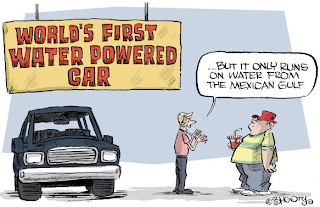
Cartoon of car that runs on water--from the Gulf of Mexico
 ~ Still thinking about water leaks today, which got me to thinking about oil leaks, especially since yesterday was the 3rd anniversary of the start of the BP Deepwater Horizon well fiasco in the Gulf of Mexico.

It started with the death of 11 people, and continued on with the gushing of nearly 5 millions barrels of oil over the next 3 months. 2 million gallons of Corexit, a toxic "dispersant", was dumped into the Gulf as well, with the misleading narrative that it was part of the "clean up" effort. The idea that one can fix a toxic mess by dumping more toxins on it is ridiculous on its face, but that's what happened, and it remains part of the standard procedure that Big Oil uses and intends to use in future. Worse, the practice is cited as a justification for how they should be allowed to continue the environmentally dangerous (and eventually disastrous) practice of drilling in ecologically sensitive areas like the ocean.

Dumping Corexit in the oil-besotted Gulf simply moved the oil from the surface down the water column to the ocean floor, where it remains today, poisoning the surroundings and entering the food chain. It is to Gulf cleaning as sweeping dirt under a rug is to house cleaning. Corexit hasn't cleaned up the Gulf nearly as much as it has BP's PR problem. We don't see images of writhing oil-soaked wildlife so much any more, but the deadly health impacts aren't gone. Corexit inhibits the natural (albeit slow) breaking down of oil by microbes, even as it makes the toxins more absorbent to people and animals. Corexit made the problem much worse.

The recovery in the Gulf has never been what we have been told it was, and policy-makers, abetted by public amnesia, continue to make poor choices on energy priorities. The industry and its political shills continue to insist that we should trust them when they swear (no, really!) that such a horror won't occur again, and, without irony, that if it does, they'll be ready. It's the same old promise, and is as hollow now as it was then. The real lessons and solutions are altogether different.

Sunday, February 3, 2013

Tough Oversight

But the Focus is Misplaced


Doc Hastings
 ~ Even as oil drilling continues to set new records, Congress will be closely monitoring... the regulators!
Tough scrutiny “is more important than ever,” said Rep. Doc Hastings, R-Wash., at the opening meeting of his Natural Resources Committee... Hastings said his panel’s role will be to keep pace and ensure any new “regulations and actions are thoroughly scrutinized and challenged if necessary.”
Doc Hastings is a continuing embarrassment to the US House. Would that he expended the same energy to thoroughly scrutinizing the cavalier and environmentally short-cutting drilling industry that he squanders instead on those trying to honestly regulate it on the public's behalf.

When it comes to scrutinizing the industry, Hastings and his panel do too much overlooking and too little overseeing.

Friday, February 1, 2013

Why Renewable Energy?

Lower Cost, Lowered Volatility


 ~ Furniture and home furnishings retailer Ikea plans to double spending on renewable energy to $4B by 2020. The PR value is probably great, but saving money is the driver:
The additional spending on projects such as wind farms and solar parks will be needed to keep expenses down as the company maintains its pace of expansion, Chief Executive Officer and President Mikael Ohlsson said in an interview in Malmo, Sweden.

“I foresee we’ll continue to increase our investments in renewable energy,” said Ohlsson.
US oil prices 1946 to present
Ikea plans to get 70% of its energy consumption from renewables by 2015, and 100% by 2020. Not only are wind and solar approaching or reaching grid parity in many places, they provide pricing stability and predictability for businesses, something not provided by volatile oil prices.

Monday, January 14, 2013

Welfare Incentives—III

Dependency


 ~ No question there are those who rely on handouts for their very survival. That said, there is equally no doubt that some at street corners and freeway off-ramps sporting "God bless" signs aren't begging, but are earning a living, or even supplementing one.

Cartoon | Corporate beggars

Legions of corporate persons engage in a similar exercise, infesting the off-ramps (and on-ramps) of Capitol Hill, making lofty (if vague and unprovable) claims about jobs as they buttonhole lawmakers in search of hand-outs. God bless!


Monday, December 31, 2012

12 Predictions for 2013

Clarity Moving Beyond the Past


Tarot Deck | 6 of Swords
 ~ The best part of 2013 is that there won't be a federal election. Consequently, some useful things will get done. There will still be way too much partisan malarkey for my tastes, but the electorate expects action on a host of things and the political dynamic will allow more progress than last year's gridlocked, posturing debacle.

This year's predictions:

Sunday, December 30, 2012

My 2012 Predictions Revisited

About 3/4 Accurate


Tarot Deck | 5 of Wands
 ~ So how good was my prognostication of the past year? Not bad, although I did make some creampuff predictions that boosted the grade. Using a scale of 1 (utterly wrong) to 10 (perfectly prescient):

Saturday, December 22, 2012

Divestiture

Money Talks


Protest against apartheid South Africa, Harvard 1978
 ~ Protest and divestment work.

Seattle is the first US city to announce formal divestiture of investments in the fossil fuel industry. Mayor Mike McGinn made the announcement yesterday, making good on a promise made November 7 during 350.org's Do The Math tour. Said McGinn:
Climate change is one of the most important challenges we currently face as a city and as a society. I believe that Seattle ought to discourage these companies from extracting that fossil fuel, and divesting the pension fund from these companies is one way we can do that.

Thursday, December 13, 2012

Welfare Incentives

Our Unmotivated Oil Industry


 ~ Big Oil is getting worried about their subsidies going away as part of the action to address the so-called fiscal cliff. Horrors! They might lose their taxpayer-funded welfare! Said a letter signed by a phalanx of 14 lobbies:
Any attempts to target the oil and gas industry for punitive treatment should be avoided as higher taxes could put the economic growth we’ve created at risk.
Public support by party affiliation for various fiscal solutions

Yes, I suppose it "could" in the same way buying a lottery ticket "could" make me rich. Fat chance. But whether it is merely possible or not isn't really how we should decide this. Let's focus instead on likely outcomes. If I buy a lottery ticket I will make myself poorer by the cost of that ticket. And the potential "treatment"—reducing or eliminating taxpayer handouts to an insanely wealthy industry—is hardly "punitive." It will simply help out (a tiny bit) on our fiscal problems.

Sunday, October 21, 2012

With Friends Like These...

A Messy Relationship


 ~ At the Alberta Tar Sands, how committed are they really?
A spokesman for government department Natural Resources Canada said: "The oil sands are an important strategic resource that we are committed to developing in a socially and environmentally friendly manner." [Emphasis added]
Alberta Tar Sands tailing pond


Friday, October 19, 2012

A Renewable Saudi Arabia

Beyond Petroleum?


Saudi Prince Turki bin Faisal Al Saud
 ~ A key member of the Saudi royal family says that the kingdom aims to be powered 100% on renewable and "low-carbon forms" of energy. Maybe in his lifetime (but maybe not, because he is already 67.)

Prince Turki Al Faisal Al Saud said at a conference in Brazil:
Oil is more precious for us underground than as a fuel source. If we can get to the point where we can replace fossil fuels and use oil to produce other products that are useful, that would be very good for the world.
Some are skeptical, but the Saudis have said this before, and recognize, unlike here in the US, that oil production is not a very effective driver of economic prosperity.

Thursday, October 18, 2012

Friends of Tax Reform...

...May Not Be Friends of Big Oil


Voided subsidy check for Big Oil
 ~ Both presidential candidates share a stated desire to lower tax rates and simplify the tax code by eliminating deductions and credits. (And also those hardy but elusive scapegoats, fraud, waste and abuse.) Not everyone is fond of this idea, especially Big Oil:
“Tax reform will be a complicated process,” said Comstock, API’s manager for tax policy. “I think our members are wary of how that process will take place.
Unfortunately, tax reform by simplification entails eliminating "loopholes"—but only yours, not mine. Big Oil doesn't receive much public esteem, and their essentially indefensible billions in annual subsidies are under growing scrutiny. Even powerful House Republican and pro-fossil pol Frank Upton is talking about eliminating all energy subsidies, including for oil and gas.

Saturday, October 13, 2012

Who Sets Energy Policy?

Probably Not Anyone You Trust


Khalil Bendib cartoon on oil industry subsidies
 ~ The Gallup poll of a few months back gauged the public's views on various institutions and industry sectors.

Those with the worst public image? The federal government was almost at the bottom, just above the oil and gas industry.

Those are precisely the two who are dictating our current energy policy. Little wonder we have permanent subsidies for fossil energy and such halting progress on transitioning to a clean and sustainable energy future.