Pages

Showing posts with label environment. Show all posts

Thursday, May 30, 2013

Choosing Profits Over Planets

From the Mouths of Boobs


Rex Tillerson, Exxon CEO
 ~ "What good is it to save the planet if humanity suffers?"

So said CEO Rex Tillerson at Exxon's annual meeting yesterday. What really concerns him, of course, is less the suffering of humanity than the suffering of diminished profits. The right choice between the planet and profits? Yes! More money! Never mind that there is no business to be done on a dead planet. Or that you can't take it with you. Or that dispensing with the Earth, our only home, is somehow a reasonable option in service of unbounded cupidity. But then T. Rexx has some puzzling beliefs.

Thursday, May 9, 2013

Carbon Intoxication

Scientists are Not Immune


 ~ I've been formally trained as a computer scientist, and at one time made a very good living from it at a top institution. However, just because I am a "scientist" it does not mean that I am qualified to discourse on scientific subjects at large.

This does not, however, much deter some scientists from fulminating well outside their areas of expertise or qualification. Or spouting their personal beliefs from ideologically aligned platforms. Today we have been treated to another tired retread of an article in the Wall Street Journal by climate change simpleton William Happer. Along with astronaut Harrison Schmidt, he claims, again, that more atmospheric carbon is good for us because we need plants, and plants need carbon dioxide.

Much of the article can be dismissed on factual grounds with reference to what actual climate science and climate scientists can tell us. (I'm no expert—being a computer scientist does not make me a general scientific expert—and I happily defer to those who are.) Happer and Schmidt focus on the tired and discredited trope that carbon concentrations have been higher in geological time (true) but ignore the recent, and utterly unprecedented rate of change in those concentrations. Sure, life flourished, but not human life, and species that cannot adapt to a changing environment not infrequently suffer or become extinct. Evolution does not work well in short time periods of rapid environmental shift.


Monday, May 6, 2013

Oceans of Trash

How Long Until It's Gone?


 ~ I have found every one of these things (and more) washed up on beaches.

Graphic of how long it takes ocean trash to disintegrate

At least the ocean turns broken bottles into polished sea glass, but diapers.... there's no polishing that turd.

Friday, May 3, 2013

400 ppm

Too Much Carbon


Mauna Loa observatory carbon dioxide readings over time
 ~ Atmospheric carbon is now higher than it has been in 3 million years.
The last time CO2 reached the symbolic milestone of 400 parts per million in the atmosphere - in the Pliocene era - temperatures rose by between 3 and 4 degrees and sea levels were between five and 40 metres higher than today.
Climate change is a slow-motion calamity, but also an economic opportunity for those who seek profit. Might be a good time to start businesses building seawalls, boats, or snorkels.

Sunday, April 28, 2013

Believe It...

Soothing Sights


 ~ These places looks so astonishing it's hard to believe they exist? Guess I'll have to go see for myself. If I ever get done assembling this investor due diligence package.

Tunnel of Love, Ukraine
I want to take this train...

Sunday, April 21, 2013

Long-Term Leak Effects

A Continuing Calamity


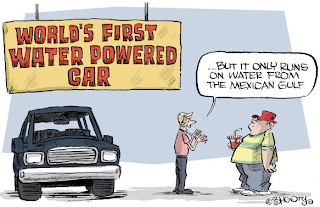
Cartoon of car that runs on water--from the Gulf of Mexico
 ~ Still thinking about water leaks today, which got me to thinking about oil leaks, especially since yesterday was the 3rd anniversary of the start of the BP Deepwater Horizon well fiasco in the Gulf of Mexico.

It started with the death of 11 people, and continued on with the gushing of nearly 5 millions barrels of oil over the next 3 months. 2 million gallons of Corexit, a toxic "dispersant", was dumped into the Gulf as well, with the misleading narrative that it was part of the "clean up" effort. The idea that one can fix a toxic mess by dumping more toxins on it is ridiculous on its face, but that's what happened, and it remains part of the standard procedure that Big Oil uses and intends to use in future. Worse, the practice is cited as a justification for how they should be allowed to continue the environmentally dangerous (and eventually disastrous) practice of drilling in ecologically sensitive areas like the ocean.

Dumping Corexit in the oil-besotted Gulf simply moved the oil from the surface down the water column to the ocean floor, where it remains today, poisoning the surroundings and entering the food chain. It is to Gulf cleaning as sweeping dirt under a rug is to house cleaning. Corexit hasn't cleaned up the Gulf nearly as much as it has BP's PR problem. We don't see images of writhing oil-soaked wildlife so much any more, but the deadly health impacts aren't gone. Corexit inhibits the natural (albeit slow) breaking down of oil by microbes, even as it makes the toxins more absorbent to people and animals. Corexit made the problem much worse.

The recovery in the Gulf has never been what we have been told it was, and policy-makers, abetted by public amnesia, continue to make poor choices on energy priorities. The industry and its political shills continue to insist that we should trust them when they swear (no, really!) that such a horror won't occur again, and, without irony, that if it does, they'll be ready. It's the same old promise, and is as hollow now as it was then. The real lessons and solutions are altogether different.

Sunday, February 3, 2013

Tough Oversight

But the Focus is Misplaced


Doc Hastings
 ~ Even as oil drilling continues to set new records, Congress will be closely monitoring... the regulators!
Tough scrutiny “is more important than ever,” said Rep. Doc Hastings, R-Wash., at the opening meeting of his Natural Resources Committee... Hastings said his panel’s role will be to keep pace and ensure any new “regulations and actions are thoroughly scrutinized and challenged if necessary.”
Doc Hastings is a continuing embarrassment to the US House. Would that he expended the same energy to thoroughly scrutinizing the cavalier and environmentally short-cutting drilling industry that he squanders instead on those trying to honestly regulate it on the public's behalf.

When it comes to scrutinizing the industry, Hastings and his panel do too much overlooking and too little overseeing.

Saturday, February 2, 2013

Sustainable Investment

Growing Worldwide


Investing hand-in-hand with social aims
 ~ Environmental, social or governance concerns are incorporated in the selection or management of more than $13T of professionally managed investments according to a new report issued under the auspices of new group Global Sustainable Investment Alliance.
Nearly 22 percent of professionally managed assets around the world can be considered sustainable or responsible, according to a finance industry assessment, the first comprehensive look at the subject.
Critics question the rigor of such terms as "sustainable"; a more accurate total might be less than 22% considering the temptation towards greenwashing that still persists in many a hidebound industry.
“It is a huge problem that there are no set criteria used by industry today to define ‘sustainable’ practices or investments – on what basis are these claims being made and who has vetted any such criteria?” [said] Anuradha Mittal, the executive director of the Oakland Institute... “Investment is necessary, but only if investment criteria are first vetted by local communities, to incorporate labour, environmental and social concerns. Given that no such standards exist, and given that corporate accountability remains a major difficulty, this is extremely problematic. We need to see that investment is actually elevating communities and natural systems, because that’s what the world needs.”
Whether 22% or a smaller figure, there is a better question than one of methodology or definition.

Why are 78% (or more) of all investments unsustainable, irresponsible, or both?

Tuesday, January 29, 2013

Fracking Radiation

Where Does It Go?


Radiation warning sign
 ~ Hazardous waste requires proper disposal so the hazard doesn't do damage, but what happens when no one is paying attention to the waste?

The Marcellus shale has a lot of radioactive uranium and radium-226 in it. As a result, the large volume of wastewater created by fracking is highly radioactive.
[U.S. Geological Survey research geologist Mark] Engle co-authored a USGS report that found that millions of barrels of wastewater from unconventional (fracked) wells in Pennsylvania and vertical wells in New York were 3,609 times more radioactive than the federal limit for drinking water and 300 times more radioactive than a Nuclear Regulatory Commission limit for industrial discharges to water.

Monday, January 21, 2013

When Trees Grow to the Sky

Milan's Vertical Forest


Bosco Verticale | Vertical Forest building in Milan, Italy
 ~ A novel take on a green-walled building is under construction in Milan.

The Bosco Verticale (Vertical Forest) places trees on custom-designed ledges all the way up the outside walls of the two apartment towers.
Each apartment balcony will have trees (900 plantings are planned for the two buildings) that will provide shade in the summer and drop their leaves in winter to allow in winter sunlight. Plant irrigation is provided via a grey-water filtration. Additionally, photovoltaic power generation will help provide sustainable power to the building.

Saturday, January 12, 2013

Nuke Waste, Guns & Plastic Bags

Digital Mosaics


Chris Jordan | Titanic mushroom clouds
 ~ There's more here than initially meets the eye.

Click on the image to go to artist Chris Jordan's site to find that the image is composed of 67,000 photos of mushroom clouds.

Monday, December 31, 2012

12 Predictions for 2013

Clarity Moving Beyond the Past


Tarot Deck | 6 of Swords
 ~ The best part of 2013 is that there won't be a federal election. Consequently, some useful things will get done. There will still be way too much partisan malarkey for my tastes, but the electorate expects action on a host of things and the political dynamic will allow more progress than last year's gridlocked, posturing debacle.

This year's predictions:

Sunday, December 30, 2012

My 2012 Predictions Revisited

About 3/4 Accurate


Tarot Deck | 5 of Wands
 ~ So how good was my prognostication of the past year? Not bad, although I did make some creampuff predictions that boosted the grade. Using a scale of 1 (utterly wrong) to 10 (perfectly prescient):

Tuesday, December 18, 2012

Zero-Waste

3 Steps


Material and waste flowchart

 ~ Zero-waste, the goal, the practice, of becoming landfill-free, is an objective of a growing number of organizations. Those that have either achieved zero-waste or are in the midst of a zero-waste initiative have had success with a three-pronged approach according to Ashley Halligan:
  1. Setting and defining a goal. Or a series of them. Zero-waste is a great goal, but initially getting to 80% of zero-waste can be a stretch effort, significant and laudable.
  2. Engage Employees. Empowering your employees produces some powerful results.
  3. Audit-and Tackle-Your Waste Stream. You can't manage (and mitigate) what you can't measure.
Quoting Kirk Varga:
When approaching a zero-waste goal, it’s important to consider that all materials are recyclable or reusable in one way or another.
For organizations, indeed, for businesses of any size, reducing waste means saving money. Consider: there are costs entailed in every component or constituent part of anything one buys. Discarding a portion of that is just trashing money. Best to buy only what one actually, and in an enduring way, uses. Otherwise, "rent" the materials—deploying them usefully, but acquiring and divesting them as part of an unending loop. Not to the land-fill, but to another use.

Saturday, November 24, 2012

Climatestorms

Superstorm Semantics Are Superbad


'Bad News' Brown
 ~ What media maven came up with the hyperventilating term "Superstorm" Sandy? Despite its destructive power, media types remain seemingly disappointed that they can't technically call Sandy a hurricane. So to heighten the seriousness of the story and of themselves, they award the generic and over-used prefix "super" to the storm.

This makes storms like Sandy seem dangerously larger in importance, and in potency, perhaps not a bad thing. But the cartoonish connotation of super as overwhelming implies these storms as a force beyond our control. We cower in helplessness upon the Supervillain's wanton destruction of the fair metropolis; should we bow down to the Superstorm? No, Superman will save us! No need for us to do anything!

Sunday, November 4, 2012

Climate Change Ocean Rise

Interactive Global Map


Puget Sound 5m higher
 ~ What would Puget Sound look like if it were 5m higher? Among other changes:
  • The Ports of Tacoma and Seattle are under water
  • So is most of Sodo, Georgetown and several neighborhoods all the way to Tukwila
  • A much smaller Everett is a narrow penisula jutting north from Mukilteo
  • Mount Vernon is on the coast
  • Tsawwassen is an island
  • In British Columbia, all of Delta and Richmond, including Vancouver Airport, and most of Highway 99, is under the Strait of Georgia
How much will the oceans rise? No one knows for sure, but careful estimates over the next century are for 5m or more. Climate change also brings more frequent and ferocious storms. Storm surges can raise ocean levels 5m or more on their own.

Check out the interactive map to see the effect of rising ocean levels of 1 to 60m anywhere in the world.

Tuesday, October 30, 2012

When the Wind Dies Down

Sandy


Sandy flooded streets
 ~ In the breathless coverage of hurricane post-tropical storm storm Sandy, our warming climate gets the cold shoulder.
There is a tide in the affairs of men, which, taken at the flood, leads on to fortune. We must take the current when it serves, or lose our ventures.
-- Shakespeare

Wind turbine behind Sandy storm surge
What is the next tide?

Sunday, October 21, 2012

With Friends Like These...

A Messy Relationship


 ~ At the Alberta Tar Sands, how committed are they really?
A spokesman for government department Natural Resources Canada said: "The oil sands are an important strategic resource that we are committed to developing in a socially and environmentally friendly manner." [Emphasis added]
Alberta Tar Sands tailing pond