Pages

Showing posts with label greenwashing. Show all posts

Thursday, May 23, 2013

Another Kind of Oil Rig

I'm Shocked. Shocked!


Shell official walks away, head hanging
 ~ Ho hum. Another case of a rapacious global corporate cartel caught doing what comes naturally.

European officials are investigating BP, Shell and Statoil for fixing the price of oil. The US may do so as well.
[UK Energy officials] said manipulation of the oil price could have driven inflation and pointed out that the market is an important benchmark for many financial transactions.

High oil prices also feeds through to bigger bills for food, clothes and other essentials because it pushes up the cost of transport and manufacturing.

A high oil price will also fuel inflation, which erodes the value of people’s savings, and can stifle economic growth, by pushing up businesses’ costs.
The economic impact of artificially inflated oil prices is huge; $20T worth of oil is priced from the Brent crude index, a focus of investigators. As with the LIBOR rate fixing scandal, it turns out the largest players "report" prices which are then aggregated and used as the benchmark for everyone else. What stops them from playing games with those reports? Nothing, except apparently the danger of being caught due to an excess of greed.

Sunday, May 12, 2013

What Big Oil Can Learn from the Gun Manufacturers

Astroturfing Savvy


 ~ Big Oil could learn a lot about faking broad public support from the gun lobby.

Big Finance astroturf how-to

Thursday, May 9, 2013

Carbon Intoxication

Scientists are Not Immune


 ~ I've been formally trained as a computer scientist, and at one time made a very good living from it at a top institution. However, just because I am a "scientist" it does not mean that I am qualified to discourse on scientific subjects at large.

This does not, however, much deter some scientists from fulminating well outside their areas of expertise or qualification. Or spouting their personal beliefs from ideologically aligned platforms. Today we have been treated to another tired retread of an article in the Wall Street Journal by climate change simpleton William Happer. Along with astronaut Harrison Schmidt, he claims, again, that more atmospheric carbon is good for us because we need plants, and plants need carbon dioxide.

Much of the article can be dismissed on factual grounds with reference to what actual climate science and climate scientists can tell us. (I'm no expert—being a computer scientist does not make me a general scientific expert—and I happily defer to those who are.) Happer and Schmidt focus on the tired and discredited trope that carbon concentrations have been higher in geological time (true) but ignore the recent, and utterly unprecedented rate of change in those concentrations. Sure, life flourished, but not human life, and species that cannot adapt to a changing environment not infrequently suffer or become extinct. Evolution does not work well in short time periods of rapid environmental shift.


Sunday, April 21, 2013

Long-Term Leak Effects

A Continuing Calamity


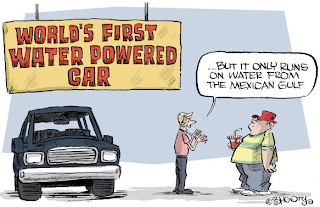
Cartoon of car that runs on water--from the Gulf of Mexico
 ~ Still thinking about water leaks today, which got me to thinking about oil leaks, especially since yesterday was the 3rd anniversary of the start of the BP Deepwater Horizon well fiasco in the Gulf of Mexico.

It started with the death of 11 people, and continued on with the gushing of nearly 5 millions barrels of oil over the next 3 months. 2 million gallons of Corexit, a toxic "dispersant", was dumped into the Gulf as well, with the misleading narrative that it was part of the "clean up" effort. The idea that one can fix a toxic mess by dumping more toxins on it is ridiculous on its face, but that's what happened, and it remains part of the standard procedure that Big Oil uses and intends to use in future. Worse, the practice is cited as a justification for how they should be allowed to continue the environmentally dangerous (and eventually disastrous) practice of drilling in ecologically sensitive areas like the ocean.

Dumping Corexit in the oil-besotted Gulf simply moved the oil from the surface down the water column to the ocean floor, where it remains today, poisoning the surroundings and entering the food chain. It is to Gulf cleaning as sweeping dirt under a rug is to house cleaning. Corexit hasn't cleaned up the Gulf nearly as much as it has BP's PR problem. We don't see images of writhing oil-soaked wildlife so much any more, but the deadly health impacts aren't gone. Corexit inhibits the natural (albeit slow) breaking down of oil by microbes, even as it makes the toxins more absorbent to people and animals. Corexit made the problem much worse.

The recovery in the Gulf has never been what we have been told it was, and policy-makers, abetted by public amnesia, continue to make poor choices on energy priorities. The industry and its political shills continue to insist that we should trust them when they swear (no, really!) that such a horror won't occur again, and, without irony, that if it does, they'll be ready. It's the same old promise, and is as hollow now as it was then. The real lessons and solutions are altogether different.

Saturday, February 2, 2013

Sustainable Investment

Growing Worldwide


Investing hand-in-hand with social aims
 ~ Environmental, social or governance concerns are incorporated in the selection or management of more than $13T of professionally managed investments according to a new report issued under the auspices of new group Global Sustainable Investment Alliance.
Nearly 22 percent of professionally managed assets around the world can be considered sustainable or responsible, according to a finance industry assessment, the first comprehensive look at the subject.
Critics question the rigor of such terms as "sustainable"; a more accurate total might be less than 22% considering the temptation towards greenwashing that still persists in many a hidebound industry.
“It is a huge problem that there are no set criteria used by industry today to define ‘sustainable’ practices or investments – on what basis are these claims being made and who has vetted any such criteria?” [said] Anuradha Mittal, the executive director of the Oakland Institute... “Investment is necessary, but only if investment criteria are first vetted by local communities, to incorporate labour, environmental and social concerns. Given that no such standards exist, and given that corporate accountability remains a major difficulty, this is extremely problematic. We need to see that investment is actually elevating communities and natural systems, because that’s what the world needs.”
Whether 22% or a smaller figure, there is a better question than one of methodology or definition.

Why are 78% (or more) of all investments unsustainable, irresponsible, or both?

Sunday, October 21, 2012

With Friends Like These...

A Messy Relationship


 ~ At the Alberta Tar Sands, how committed are they really?
A spokesman for government department Natural Resources Canada said: "The oil sands are an important strategic resource that we are committed to developing in a socially and environmentally friendly manner." [Emphasis added]
Alberta Tar Sands tailing pond


Friday, August 10, 2012

Scavenging

E-Waste isn't Recycled


E-waste on the riverbank in Guiyu, China
 ~ Most people with any environmental consciousness know not to throw obsolete or nonfunctional electronics in the trash. Such e-waste ends up in landfills where, over time, they release dioxins, heavy metals and other poisons into the ground and ultimately into the water table.

Sadly, "recycling" e-waste is little better, and arguably worse.
Guiyu, China is often referred to as the “e-waste capital of the world.” The city employs over 150,000 e-waste workers that toil through 16-hour days dis-assembling old computers and recapturing whatever metals and parts they can re-use or sell. This is far from an organized operation, however. Rather than having computers neatly stacked on palettes in storage units waiting to be recycled, computer carcasses are strewn about the streets and river banks. Huge tangles of wires and cables lay on street corners. Workers, whom will usually specialize in dis-assembling specific parts, will pull parts from the various scattered piles of parts about town and begin their work right on the street.

Saturday, July 14, 2012

Climate Change Adaptation

"We'll Adapt to That"


Alfred E. Newman
 ~ Those who deny climate change and its obvious impacts use many rationalizations. As these become harder to plausibly defend, there is a growing trend away from denying the reality to denying the significance of the impacts.

Embedded in the latest Climate Crock of the Week (video embedded below) is footage of Exxon CEO Rex Tillerson providing just such a blithe dismissal:
What do you want to do to adapt to [climate change]? And as human beings, as a species, that's why we're all still here. We have spent our entire existence adapting...

Changes to weather patterns that move crop production areas around—we'll adapt to that...

It's an engineering problem, and it has engineering solutions...

What do you want to do to adapt to that?
Yes, that's the right question to ask. So, what's the answer?

Tuesday, May 1, 2012

Social Change

Time to Aim Higher than CSR


Map of Gross National Happiness
 ~ My one-time high school classmate, Paul Klein, is now a sometime blogger for Forbes, where he pens thoughtful pieces arising from his work advising corporations on CSR, Corporate Social Responsibility. Today he published a piece on "the business value of social change."

It's a worthwhile read, and raises an intriguing point that incessant blather about CSR conveniently skirts: can CSR alone make a real difference when it remains subservient to the core corporate purpose of maximizing profit?

Sunday, April 22, 2012

Earth Day...

...And Every Other Day


Matson cartoon | Earth Day (and every other day)

 ~ Things that matter should not be relegated to an event.

Monday, September 19, 2011

Recycling the Gyres

Method Madness


Lisa Jackson (EPA), Adam Lowry of Method, and Karen Mills (SBA)
 ~ Innovative company Method made a splashy announcement last week: they've made bottles from plastic recycled from the North Pacific Gyre.

This ocean plastic covers an area the size of Texas, and is the largest of 5 such floating garbage patches, one in each of the world's large ocean gyres.

However, most of the plastic pieces are so tiny that they can barely be seen, except by marine life that mistakes the plastic for food. The ingested plastic and its constituent chemicals and contaminants then enter the food chain.

Method has done well to call attention to the problem, and being flanked by EPA Administrator Lisa Jackson and SBA chief Karen Mills is a nice PR coup for sure, but there's no new business that comes out of this, nor any sustained environmental cleanup, despite the presence of the two powerful agency heads.

Why?

Thursday, February 10, 2011

A More Frugal Economy

Remarks by Futurist Glen Hiemstra at WCTA


Futurist Glen Hiemstra presents to the Washington Cleantech Alliance
I had the pleasure yesterday of introducing Glen Hiemstra to the monthly breakfast meeting of the Washington Clean Tech Alliance (WCTA). Glen gave a wide-ranging but thematically coherent and engaging talk on what the future might hold over the next 10-50 years. One key point was how we have moved, perhaps permanently, to a "frugal economy" where people have less, buy less, and want less. It may be making a virtue of necessity for some, but for others, especially those focused on sustainability, it has a deeply satisfying appeal.

Saturday, October 23, 2010

Climate Change Ignorance

Majority of Americans Flunk Basics


Yale University's Project on Climate Change Communication
Yale University Project on
Climate Change Communication
In a survey by Yale University's Project on Climate Change Communication, 52% of Americans fail the basics in their understanding of climate change. The ignorance, however, does not stop many Americans from holding strong positions on what climate change is, whether it is happening, the extent it is caused by human activity, and whether scientists are credible. Worse still is the faulty belief that there remains a scientific rather than opinionated controversy:
...39% of people believe most scientists think global warming is happening while 38% believe there's a lot of disagreement between scientists. Nothing could be further from the truth, at least in the field of science where it matters most: climate science. Poll after poll has shown that almost 100% of climate scientists accept the evidence of climate change and believe we're the main cause. This shows a deep failure by the media to show the true nature of the debate.

The two percent of researchers who aren't in agreement deserve to heard. But they do not deserve equal time in the media. Imagine if you owned 98% of a business but your less-knowledgeable partner with only two percent had as much sway as you. It's a ridiculous way to approach business and a ridiculous way to present such an important issue.
Among other findings of the study:

Sunday, October 3, 2010

We're All Guinea Pigs Now

No Exit: Corexit in the Foodchain


Corexit is claimed, without benefit of much proof, to be safe. But do we really know what it's doing to the ecosystem in the Gulf of Mexico? Judge for yourself:


It'll be a while before I eat the seafood.

Also sickening: Nalco, the maker of Corexit, is a new addition to the Dow Jones Sustainability Indexes.

Friday, September 24, 2010

Dow Jones Sustainability Index

The New Greenwashing


Painting a wall gray or green
Not really being green.
Instead, shades of gray
The value of being sustainable is increasingly recognized and there is a growing movement to be sustainable and to select sustainable businesses and practices. No surprise then that hype and confusion are also growing, especially where there is money at stake. The Dow Jones Sustainability Indexes "track the financial performance of the leading sustainability-driven companies worldwide."
The Dow Jones Sustainability World Index (DJSI World) covers the top 10% of the biggest 2,500 companies in the Dow Jones Global Total Stock Market Index in terms of economic, environmental and social criteria.
So no surprise after the Gulf of Mexico disaster they removed BP from the list.
As a component of the DJSI World Index, BP was subject to index rules that allow for elimination from the DJSI following extraordinary events... The extent of the oil-spill catastrophe in the Gulf of Mexico and its foreseeable long-term effects on the environment and the local population – in addition to the economic effects and the long term damage to the reputation of the company – were included in the analysis leading up to BP’s removal.
Monitoring of crisis events
assess how well the company informs the public, acknowledges responsibility, provides relief measures, involves relevant stakeholders and develops solutions.
But wait! Who's the new company they just added? Darth Cheney's Haliburton?! Really? This is, after all, a company also complicit in fouling the Gulf.

We are left to draw one of two wretched conclusions:
  • "Sustainability" means something a bit different to Dow Jones.
  • Haliburton really is in the 90th percentile in sustainability amongst the 2500 largest global corporations.