Pages

Showing posts with label efficiency. Show all posts

Friday, January 25, 2013

Sextuplicate

IRS Forms Only Your Grandpa Could Love


Remington typewriter
 ~ I expect some of my readers may not even know what carbon paper is, or its somewhat more modern, but still ancient relative, carbonless copy paper. If you have received a W-2 or a 1099-MISC income statement from a small business, however, you may have received it printed on one of these papers.

It is bizarrely retro.

Monday, January 21, 2013

When Trees Grow to the Sky

Milan's Vertical Forest


Bosco Verticale | Vertical Forest building in Milan, Italy
 ~ A novel take on a green-walled building is under construction in Milan.

The Bosco Verticale (Vertical Forest) places trees on custom-designed ledges all the way up the outside walls of the two apartment towers.
Each apartment balcony will have trees (900 plantings are planned for the two buildings) that will provide shade in the summer and drop their leaves in winter to allow in winter sunlight. Plant irrigation is provided via a grey-water filtration. Additionally, photovoltaic power generation will help provide sustainable power to the building.

Monday, January 7, 2013

How to Get Stuff Done

Making It As Simple As ABC


Multi-tasking
 ~ I've multi-tasked for many years, even though I've heard it argued that true multi-tasking is impossible. We can really only do one thing at a time, and trying to do several things at once simply results in doing several things not very well, and perhaps completing none of them. It leads to all quantity and no quality.

The argument is both true and irrelevant.

It's true inasmuch as we can't really focus on more than one thing at a time. It's irrelevant because it's not only unnecessary, but detrimental, and it's not really what people mean by multi-taasking.

Tuesday, December 18, 2012

Zero-Waste

3 Steps


Material and waste flowchart

 ~ Zero-waste, the goal, the practice, of becoming landfill-free, is an objective of a growing number of organizations. Those that have either achieved zero-waste or are in the midst of a zero-waste initiative have had success with a three-pronged approach according to Ashley Halligan:
  1. Setting and defining a goal. Or a series of them. Zero-waste is a great goal, but initially getting to 80% of zero-waste can be a stretch effort, significant and laudable.
  2. Engage Employees. Empowering your employees produces some powerful results.
  3. Audit-and Tackle-Your Waste Stream. You can't manage (and mitigate) what you can't measure.
Quoting Kirk Varga:
When approaching a zero-waste goal, it’s important to consider that all materials are recyclable or reusable in one way or another.
For organizations, indeed, for businesses of any size, reducing waste means saving money. Consider: there are costs entailed in every component or constituent part of anything one buys. Discarding a portion of that is just trashing money. Best to buy only what one actually, and in an enduring way, uses. Otherwise, "rent" the materials—deploying them usefully, but acquiring and divesting them as part of an unending loop. Not to the land-fill, but to another use.

Monday, December 10, 2012

Who Needs a Business Plan?

Show, Don't Tell


Scribe writing
 ~ Brad Feld, startup luminary, writes that the business plan has become an historical artifact.

He's right. Mostly.

It's certainly true that there's much less demand by investors for full-fledged business plans now than when I was starting my life as an entrepreneur 15 years ago. I'm just finishing up raising a seed capital round now, and of the roughly one dozen investors already in, not a single one has asked for the business plan. Why? None have told me, and I didn't ask, but it's not hard to guess—the only thing possibly more tedious than writing a business plan is reading one.

Monday, October 1, 2012

Making Public Transit Harder to Take

The End of the Ride Free Area


Crowds pack the Seattle Transit Tunnel
 ~ "Back door!"

So shouted the tired office worker in the direction of the Metro Transit bus driver down the Westlake Station platform of the Seattle Transit Tunnel.

The driver didn't respond. The commuter, wearily, headed toward the front door of the bus, annoyance clearly visible on her face. Boarding through all doors was already a dim memory.

It was just past 5:30 on the first weekday following the elimination of Seattle's downtown ride free area and clearly not everyone was with the new program. Metro did away with the downtown Ride Free Area in an attempt to save the $2.2M of evaded fares in their operating budget of $549M. Those relatively meager (and theoretical) savings are changing the ease, appeal and convenience of taking public transit.

Sunday, September 23, 2012

Why Clean Energy Matters

It's The Emissions, Stupid


 ~ It's a significant part of the greenhouse gas emissions problem:

World Greenhouse Gas Emissions by Sector
Graphic by Emmanuelle Bournay, UNEP/GRID-Arendal

What part of this surprises you the most?

Learn more about the UN Environmental Programme here.

Download high-resolution versions of this graphic here.

Monday, August 13, 2012

Olympic Transport

Tubing in London


 ~ Olympians can be role models for more than their athletic prowess. Check out the gold medal means of getting around:

US gold medal-winning men's basketball team taking public transportation at London Olympics

The US men's gold medal-winning basketball team weren't the only Olympians skipping the limo and the various other chauffeured options, either. Also seen on the Tube were medalists from Venezuela, the UK (of course) and Rwanda, as well as other Americans.

Public transit, offering "cachet as well as convenience" is, as Chris Paul tweeted, a #fasterwaybacktothehotel.


Cross-posted to Fare Free Northwest blog.

Tuesday, July 31, 2012

Coal and Wind

Blackouts in India


Map showing India power outage
 ~ As much as 10% of the world's population is without electricity following the second massive grid outage in India this week.

Blame is being spread around among an outdated, rickety grid, a lack of generation capacity, government inefficiency and corruption, a failure to follow agreed-to consumption limits by various states, poor energy pricing that encourages wasteful consumption, and, as one routinely expects from the corporate cheer-leading quarter, supposedly strangling environmental regulations. All of these are true at least in part, but the bigger cause is a failure to plan and build a stronger commitment to renewable energy.

Thursday, March 29, 2012

Milking

A Grim Future


 ~ As the old saw puts it, who will buy the cow when you can get the milk for free? Naked Capitalism:
[As] the chart below underscores, the US changed in the early 1980s from a model where rising worker wages were seen as the driver to ...growth and hence a focus of policy, to one where rising consumer debt levels and asset appreciation were used to substitute for stagnant incomes.
Chart: rising productivity, stagnating wages

There are some disturbing parallels to the rise in the value of slaves prior to the Civil War, and the insight into capitalist thinking is disquieting in light of current events:

Friday, March 2, 2012

Gas Price Blame

Whose Fault Are High Gas Prices?


Ed Stein cartoon | Right wing complaints about gas prices
 ~ Gas prices always go up in spring (why?) and this year they are rising faster and farther than ever before. Especially since it's an election year, the GOP wants to blame Obama.

Saturday, February 18, 2012

A Week in the Life

How CEOs Divide Their Time


 ~ According to the Wall Street Journal, the typical CEO of a Fortune 500 company spends about a third of his work time in meetings:
In one sample of 65 CEOs, executives spent roughly 18 hours of a 55-hour workweek in meetings, more than three hours on calls and five hours in business meals, on average.
This doesn't surprise me.

What does surprise me, however, is that they spend more time—20 hours a week—on things most of us do not consider work: "Travel, exercise, personal appointments and other activities."

The CEO work week on average

Friday, December 30, 2011

My 2011 Predictions Revisited

About 2/3 Accurate


The Tarot | The Tower
 ~ A year ago I took a stab at predictions for 2011. Seems like I've run out of time waiting for most of them to come to pass, so it's time for a report card, using a scale of 1 (utterly wrong) to 10 (perfectly prescient):

Thursday, December 22, 2011

Electricity in the Developing World

Small Scale, Local Generation


Satellite view of Africa at night
 ~ The need for electricity throughout the developing world is immense and will continue to grow. Unlike in the industrialized countries, much of the developing world does not have large centralized power plants and transmission lines to carry that power to widely-spread users. Nor are they likely to ever have such a system:
Building out the power grid can be prohibitively expensive, which is why in many countries, like Haiti, less than three quarters of the population have grid access. Pike Research’s Clint Wheelock says just for the transmission portion alone it can cost at least $500,000 per mile. And that’s without the distribution portion and any kind of the grid intelligence (smart grid) that is getting all of the investment this year.

Thursday, December 15, 2011

Wind Up

FERC Sides with Wind Farms Over BPA


Wind turbines integrated with hydro in Quebec
 ~ How much do we need a smart grid?

Last week the Federal Energy Regulatory Commission (FERC) ruled that the Bonneville Power Administration (BPA) cannot use its monopoly power to force wind farm operators to curtail generation, an action the BPA took in response to a surfeit of hydro power this past spring.

At the time, BPA claimed that they had to curtail wind generation to protect salmon populations. Wind producers argued that BPA should have continued to buy all their generation and could have sold the power elsewhere. BPA's decision cost them both crucial revenue and the production tax credits on which their financing, and hence, the overall project viability, depended.

FERC has now largely agreed with the wind farm operators that BPA could have sent the power to California and instead curtailed generation there.
Wind farm owners, including independent developers and utilities who own their own projects, say the problem is about money, not too much electricity.

"The agency has painted this issue as being about fish and physics," said Stefan Bird, senior vice president at PacifiCorp Energy. "It's about discrimination and dollars."

Tuesday, December 13, 2011

We Need More Public Transit

And Public Transit Needs Us


 ~ Why public transit?

Riffing on Stuart Smalley: It's good enough, it's smart enough, and doggone it, people like it!

Americans, regardless of political affiliation, support public transit. Everyone who takes public transit contributes to decreased congestion, decreased carbon emissions, and decreased oil/gas use. It's funny to think otherwise. Public transit riders also save money.

Public transit revitalizes communities and leads to economic (re-)development. People choose public transit if given a level of service that represents something close to a comparable choice. Public funding of public transit makes sense, and smart political leadership just gets it done. Unfortunately, others still don't get it.

The demographics in America are changing. The outer ring suburbs are dying and not coming back; both empty-nest Boomers and younger Millennials want to live in livable, walkable cities well-served by public transit where they don't even need to own cars.

Why support pubic transit? It's really rather simple:


Public transit: good, smart, and people like it.


Cross-posted to Fare-Free NW blog.

Sunday, October 16, 2011

Feeding the World

It's Getting Harder To Do


Phytelligence-grown Pinot Meunier plantlet
 ~ World population continues to grow exponentially, but, as Malthus observed, our food production is not keeping pace. Worse, feeding those alive today is getting harder:
  • Some food crops (e.g. corn) are diverted for making fuels
  • Fresh water supplies are dwindling or under threat
  • Modern agriculture is heavily dependent on fossil fuel inputs for transportation and fertilizer
  • Arable land is vanishing to development and to erosion
To produce enough food for everyone there will need to be many coordinated solutions. One partial solution would be to grow more plants in less space with fewer energy inputs. A new startup company spun out of WSU has technology that does exactly that.

Phytelligence makes smarter plants, or rather, has a smarter process for propagating them and boosting them through their earliest (plantlet) growth stage. It's not genetic engineering, or GMO, but rather the smart application of proprietary technology to grow vigorous and healthy plantlets in less time, at less cost, and with less water and energy.

The Company has already successfully propagated 4 of the top 5 fruits in the US as measured by crop value and by acres planted. There is enormous opportunity in other fruits, tree nuts, and other kinds of crops generally. The nursery business has seen little change in generations; Phytelligence is aiming to bring to the industry 21st Century technology, sustainability practices and logistics.

Come learn more about Phytelligence at the NWEN First Look Forum, this Tuesday, 3:00-5:00 at the Arctic Hotel in Seattle. Reception to follow.


Update: Phytelligence finished in the top 5. Thanks to NWEN for a great event!

Tuesday, October 11, 2011

Bag End in Wales

"Hobbit" House for 3,000 Quid


 ~ Despite lacking a round door, this really does look like something out of Tolkien:

Wales hobbit house with earthen roof

Pictures of the interior evoke the coziness of the fictional home of Bilbo and Frodo:

Wales hobbit house interior

Wednesday, September 28, 2011

Where's It Wednesday—LI

Where in Seattle is this?

Somewhere in Seattle... but where?

Answer next week.

Details on the weekly Where's It Wednesday puzzle here.
Other weeks' puzzles here.
Answer to last week's puzzle, after the jump.

Monday, September 12, 2011

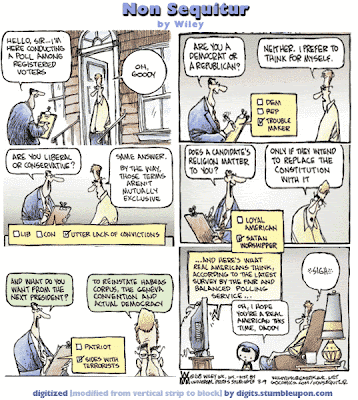
What Americans Want

And Our Politicians Don't Do


Wiley cartoon on polling
 ~ A new study of public attitudes by party shows surprising agreement on a number of issues. Majorities of voters, whether self-identifying as a Democrat, Republican, Independent or member of the Tea Party, told researchers that they
  • Support funding more research into renewable energy sources such as solar and wind power
  • Support providing tax rebates for people who purchase energy efficient vehicles or solar panels
  • Support local regulations requiring new homes to be more energy efficient
  • Support the construction of bike paths on city streets
  • Support increasing the availability of public transportation in their county
  • Believe protecting the environment either improves economic growth and provides new jobs or has no effect on economic growth or jobs
  • Trust scientists as a source of information about global warming
  • Support expansion of offshore drilling for oil and natural gas off the U.S. coast
So why is that, except for the last item, our politicians appear unable to advance any of these things?
The study was conducted by the Yale Project on Climate Change Communication and the George Mason University Center for Climate Change Communication, and was funded by the Surdna Foundation, the 11th Hour Project, and the Grantham Foundation for the Protection of the Environment.