Pages

Showing posts with label sustainability. Show all posts

Thursday, June 6, 2013

Blended Standards

Is E15 Gasoline Safe?


Blended gasoline and ethanol fuel choices
 ~ The American Petroleum Institute (API) is fighting the EPA over how much ethanol should be blended into gasoline. Is 15% ethanol content, E-15, safe for modern cars?
The [EPA] and the biofuels industry say the blend — which contains 15 percent ethanol, rather than the standard 10 percent — is safe for those vehicles.

But the oil and gas industry has produced studies finding that the mix would damage vehicle engines, and some automakers have said they would not honor warranties in cases where E15 was used.

“E15 could leave millions of consumers with broken down cars and high repair bills,” said Bob Greco, API group downstream director. “It could also put motorists in harm’s way when vehicles break down in the middle of a busy highway. We are asking the Supreme Court to step in and protect consumers by striking down EPA’s dangerous E15 mandate before it’s too late.”
Well, of course it "could". But will it? The API's studies have been called "scientifically weak" and there are, naturally, many other studies that show no harm. Could it be that the science is not settled?

Reminds me of another contentious argument of interest to the API...


Thursday, May 30, 2013

Choosing Profits Over Planets

From the Mouths of Boobs


Rex Tillerson, Exxon CEO
 ~ "What good is it to save the planet if humanity suffers?"

So said CEO Rex Tillerson at Exxon's annual meeting yesterday. What really concerns him, of course, is less the suffering of humanity than the suffering of diminished profits. The right choice between the planet and profits? Yes! More money! Never mind that there is no business to be done on a dead planet. Or that you can't take it with you. Or that dispensing with the Earth, our only home, is somehow a reasonable option in service of unbounded cupidity. But then T. Rexx has some puzzling beliefs.

Thursday, May 9, 2013

Carbon Intoxication

Scientists are Not Immune


 ~ I've been formally trained as a computer scientist, and at one time made a very good living from it at a top institution. However, just because I am a "scientist" it does not mean that I am qualified to discourse on scientific subjects at large.

This does not, however, much deter some scientists from fulminating well outside their areas of expertise or qualification. Or spouting their personal beliefs from ideologically aligned platforms. Today we have been treated to another tired retread of an article in the Wall Street Journal by climate change simpleton William Happer. Along with astronaut Harrison Schmidt, he claims, again, that more atmospheric carbon is good for us because we need plants, and plants need carbon dioxide.

Much of the article can be dismissed on factual grounds with reference to what actual climate science and climate scientists can tell us. (I'm no expert—being a computer scientist does not make me a general scientific expert—and I happily defer to those who are.) Happer and Schmidt focus on the tired and discredited trope that carbon concentrations have been higher in geological time (true) but ignore the recent, and utterly unprecedented rate of change in those concentrations. Sure, life flourished, but not human life, and species that cannot adapt to a changing environment not infrequently suffer or become extinct. Evolution does not work well in short time periods of rapid environmental shift.


Monday, May 6, 2013

Oceans of Trash

How Long Until It's Gone?


 ~ I have found every one of these things (and more) washed up on beaches.

Graphic of how long it takes ocean trash to disintegrate

At least the ocean turns broken bottles into polished sea glass, but diapers.... there's no polishing that turd.

Friday, May 3, 2013

400 ppm

Too Much Carbon


Mauna Loa observatory carbon dioxide readings over time
 ~ Atmospheric carbon is now higher than it has been in 3 million years.
The last time CO2 reached the symbolic milestone of 400 parts per million in the atmosphere - in the Pliocene era - temperatures rose by between 3 and 4 degrees and sea levels were between five and 40 metres higher than today.
Climate change is a slow-motion calamity, but also an economic opportunity for those who seek profit. Might be a good time to start businesses building seawalls, boats, or snorkels.

Sunday, April 21, 2013

Long-Term Leak Effects

A Continuing Calamity


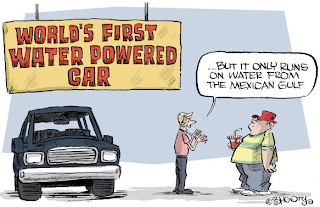
Cartoon of car that runs on water--from the Gulf of Mexico
 ~ Still thinking about water leaks today, which got me to thinking about oil leaks, especially since yesterday was the 3rd anniversary of the start of the BP Deepwater Horizon well fiasco in the Gulf of Mexico.

It started with the death of 11 people, and continued on with the gushing of nearly 5 millions barrels of oil over the next 3 months. 2 million gallons of Corexit, a toxic "dispersant", was dumped into the Gulf as well, with the misleading narrative that it was part of the "clean up" effort. The idea that one can fix a toxic mess by dumping more toxins on it is ridiculous on its face, but that's what happened, and it remains part of the standard procedure that Big Oil uses and intends to use in future. Worse, the practice is cited as a justification for how they should be allowed to continue the environmentally dangerous (and eventually disastrous) practice of drilling in ecologically sensitive areas like the ocean.

Dumping Corexit in the oil-besotted Gulf simply moved the oil from the surface down the water column to the ocean floor, where it remains today, poisoning the surroundings and entering the food chain. It is to Gulf cleaning as sweeping dirt under a rug is to house cleaning. Corexit hasn't cleaned up the Gulf nearly as much as it has BP's PR problem. We don't see images of writhing oil-soaked wildlife so much any more, but the deadly health impacts aren't gone. Corexit inhibits the natural (albeit slow) breaking down of oil by microbes, even as it makes the toxins more absorbent to people and animals. Corexit made the problem much worse.

The recovery in the Gulf has never been what we have been told it was, and policy-makers, abetted by public amnesia, continue to make poor choices on energy priorities. The industry and its political shills continue to insist that we should trust them when they swear (no, really!) that such a horror won't occur again, and, without irony, that if it does, they'll be ready. It's the same old promise, and is as hollow now as it was then. The real lessons and solutions are altogether different.

Saturday, April 20, 2013

Urban Farming

Industrial Rooftop Greenhouses


 ~ Whole Foods Markets has announced plans to erect a commercial greenhouse atop its Brooklyn store:
Artist's conception of Brooklyn Whole Foods rooftop greenhouse
Today Whole Foods Market has announced Gotham Greens as its operating partner of the nation’s first commercial scale greenhouse farm integrated within a retail grocery space. The 20,000-square-foot greenhouse, currently being constructed on the roof of the forthcoming Whole Foods Market store in Gowanus, Brooklyn, is scheduled to open later this fall. Gotham Greens will grow premium quality, pesticide-free produce year round in the greenhouse for Whole Foods Market Gowanus, as well as other Whole Foods Market locations throughout New York City.
Apart from all the benefits of having a green roof, the initiative will also grow produce that requires fewer water, energy and other inputs. Transportation costs and environmental impacts will also be minimized.

It will be interesting to see how well a retailer can vertically integrate their operations in this way. Locally, a couple of startups,including Suncrest Farms and Urban Harvest, are working on similar concepts.

If this is the start of a trend, and it sure looks like one, where are all the plants going to come from? Especially for hydroponics, tissue culture provides the best answer.

Friday, April 19, 2013

The Overview Effect

"An Incredible Aesthetic Impact"


 ~ Reflections of astronauts on how space travel changed their perspective:


Why do we explore? Push boundaries? Innovate?

To learn about ourselves.

Saturday, February 2, 2013

Sustainable Investment

Growing Worldwide


Investing hand-in-hand with social aims
 ~ Environmental, social or governance concerns are incorporated in the selection or management of more than $13T of professionally managed investments according to a new report issued under the auspices of new group Global Sustainable Investment Alliance.
Nearly 22 percent of professionally managed assets around the world can be considered sustainable or responsible, according to a finance industry assessment, the first comprehensive look at the subject.
Critics question the rigor of such terms as "sustainable"; a more accurate total might be less than 22% considering the temptation towards greenwashing that still persists in many a hidebound industry.
“It is a huge problem that there are no set criteria used by industry today to define ‘sustainable’ practices or investments – on what basis are these claims being made and who has vetted any such criteria?” [said] Anuradha Mittal, the executive director of the Oakland Institute... “Investment is necessary, but only if investment criteria are first vetted by local communities, to incorporate labour, environmental and social concerns. Given that no such standards exist, and given that corporate accountability remains a major difficulty, this is extremely problematic. We need to see that investment is actually elevating communities and natural systems, because that’s what the world needs.”
Whether 22% or a smaller figure, there is a better question than one of methodology or definition.

Why are 78% (or more) of all investments unsustainable, irresponsible, or both?

Monday, January 21, 2013

When Trees Grow to the Sky

Milan's Vertical Forest


Bosco Verticale | Vertical Forest building in Milan, Italy
 ~ A novel take on a green-walled building is under construction in Milan.

The Bosco Verticale (Vertical Forest) places trees on custom-designed ledges all the way up the outside walls of the two apartment towers.
Each apartment balcony will have trees (900 plantings are planned for the two buildings) that will provide shade in the summer and drop their leaves in winter to allow in winter sunlight. Plant irrigation is provided via a grey-water filtration. Additionally, photovoltaic power generation will help provide sustainable power to the building.

Saturday, January 12, 2013

Nuke Waste, Guns & Plastic Bags

Digital Mosaics


Chris Jordan | Titanic mushroom clouds
 ~ There's more here than initially meets the eye.

Click on the image to go to artist Chris Jordan's site to find that the image is composed of 67,000 photos of mushroom clouds.

Sunday, December 30, 2012

My 2012 Predictions Revisited

About 3/4 Accurate


Tarot Deck | 5 of Wands
 ~ So how good was my prognostication of the past year? Not bad, although I did make some creampuff predictions that boosted the grade. Using a scale of 1 (utterly wrong) to 10 (perfectly prescient):

Tuesday, December 18, 2012

Zero-Waste

3 Steps


Material and waste flowchart

 ~ Zero-waste, the goal, the practice, of becoming landfill-free, is an objective of a growing number of organizations. Those that have either achieved zero-waste or are in the midst of a zero-waste initiative have had success with a three-pronged approach according to Ashley Halligan:
  1. Setting and defining a goal. Or a series of them. Zero-waste is a great goal, but initially getting to 80% of zero-waste can be a stretch effort, significant and laudable.
  2. Engage Employees. Empowering your employees produces some powerful results.
  3. Audit-and Tackle-Your Waste Stream. You can't manage (and mitigate) what you can't measure.
Quoting Kirk Varga:
When approaching a zero-waste goal, it’s important to consider that all materials are recyclable or reusable in one way or another.
For organizations, indeed, for businesses of any size, reducing waste means saving money. Consider: there are costs entailed in every component or constituent part of anything one buys. Discarding a portion of that is just trashing money. Best to buy only what one actually, and in an enduring way, uses. Otherwise, "rent" the materials—deploying them usefully, but acquiring and divesting them as part of an unending loop. Not to the land-fill, but to another use.

Saturday, November 24, 2012

Climatestorms

Superstorm Semantics Are Superbad


'Bad News' Brown
 ~ What media maven came up with the hyperventilating term "Superstorm" Sandy? Despite its destructive power, media types remain seemingly disappointed that they can't technically call Sandy a hurricane. So to heighten the seriousness of the story and of themselves, they award the generic and over-used prefix "super" to the storm.

This makes storms like Sandy seem dangerously larger in importance, and in potency, perhaps not a bad thing. But the cartoonish connotation of super as overwhelming implies these storms as a force beyond our control. We cower in helplessness upon the Supervillain's wanton destruction of the fair metropolis; should we bow down to the Superstorm? No, Superman will save us! No need for us to do anything!

Tuesday, August 21, 2012

Buried Treasure?

Keep Fossil Fuels Buried


Leave fossil fuels in the ground
 ~ We should leave our fossil fuels in the ground.

And not just because it would keep that carbon and its climate change impacts out of the atmosphere, but also because it would add to our energy security as a country.

Keeping more of our fossil fuel wealth in the ground would increase our energy security in two ways:

Saturday, August 18, 2012

Primitive Energy

Advancing Society?


Neil deGrasse Tyson embarrassed by humanity's digging of fossil fuels
 ~ How would you explain our society to a visiting alien?

Neil deGrasse Tyson is not Bill Nye or Carl Sagan, but he is at least as effective in making science accessible and understandable to the general public.

He's embarrassed by our addiction to fossil fuels. We should all be so, because it is an indication that our society is primitive.

Why? Consider the anthropological arc of humanity.

Friday, August 10, 2012

Scavenging

E-Waste isn't Recycled


E-waste on the riverbank in Guiyu, China
 ~ Most people with any environmental consciousness know not to throw obsolete or nonfunctional electronics in the trash. Such e-waste ends up in landfills where, over time, they release dioxins, heavy metals and other poisons into the ground and ultimately into the water table.

Sadly, "recycling" e-waste is little better, and arguably worse.
Guiyu, China is often referred to as the “e-waste capital of the world.” The city employs over 150,000 e-waste workers that toil through 16-hour days dis-assembling old computers and recapturing whatever metals and parts they can re-use or sell. This is far from an organized operation, however. Rather than having computers neatly stacked on palettes in storage units waiting to be recycled, computer carcasses are strewn about the streets and river banks. Huge tangles of wires and cables lay on street corners. Workers, whom will usually specialize in dis-assembling specific parts, will pull parts from the various scattered piles of parts about town and begin their work right on the street.

Thursday, August 9, 2012

Climate Change Optimism...

...Is Unwarranted


Surface of venus
 ~ The future is now. And it is hot. Pre-eminent atmospheric physicist James Hansen:

In a new analysis of the past six decades of global temperatures, which will be published Monday, my colleagues and I have revealed a stunning increase in the frequency of extremely hot summers, with deeply troubling ramifications for not only our future but also for our present.

This is not a climate model or a prediction but actual observations of weather events and temperatures that have happened. Our analysis shows that it is no longer enough to say that global warming will increase the likelihood of extreme weather and to repeat the caveat that no individual weather event can be directly linked to climate change. To the contrary, our analysis shows that, for the extreme hot weather of the recent past, there is virtually no explanation other than climate change.

The deadly European heat wave of 2003, the fiery Russian heat wave of 2010 and catastrophic droughts in Texas and Oklahoma last year can each be attributed to climate change. And once the data are gathered in a few weeks' time, it's likely that the same will be true for the extremely hot summer the United States is suffering through right now.

These weather events are not simply an example of what climate change could bring. They are caused by climate change. The odds that natural variability created these extremes are minuscule, vanishingly small. To count on those odds would be like quitting your job and playing the lottery every morning to pay the bills.
So, do you feel lucky? Punk?

Tuesday, August 7, 2012

Drought Disaster

Truth or Consequences


 ~ Food prices are already edging up as widespread crop failures become more certain. "Dustbowlification" threatens not just more expensive food this year, but food insecurity globally for years or decades. It's another indicator that climate change is not a subject for rarified debate, but a real problem we are seeing all around us right now.

The USDA has issued its map of disaster areas affected by extreme drought—most of the country, and a serious swath of the American 'breadbasket':

USDA Secretary's drought designations

There's a long-standing drought of sensible response as well. One wonders how much longer farmers with parched land and withered crops will mock Al Gore and keep re-electing cretins like Jim Inhofe?